

How Much CO₂ Does rPET Save? Life-Cycle Analysis Explained
As brands move towards sustainable backpacks, understanding the carbon footprint of materials is critical.
rPET (recycled polyester) offers significant CO₂ reductions compared to virgin polyester, thanks to its reuse of post-consumer plastic bottles and energy-efficient processing.
In this article, we break down life-cycle analysis (LCA) data, CO₂ savings, and environmental benefits.


Life-Cycle Analysis of rPET
Life-cycle analysis evaluates environmental impact from raw material extraction to end-of-life.
rPET LCA considers:
- Collection of post-consumer plastic bottles
- Cleaning, sorting, and shredding into flakes
- Polyester polymerization and yarn extrusion
- Fabric weaving or knitting and finishing
- Transport, packaging, and product manufacturing
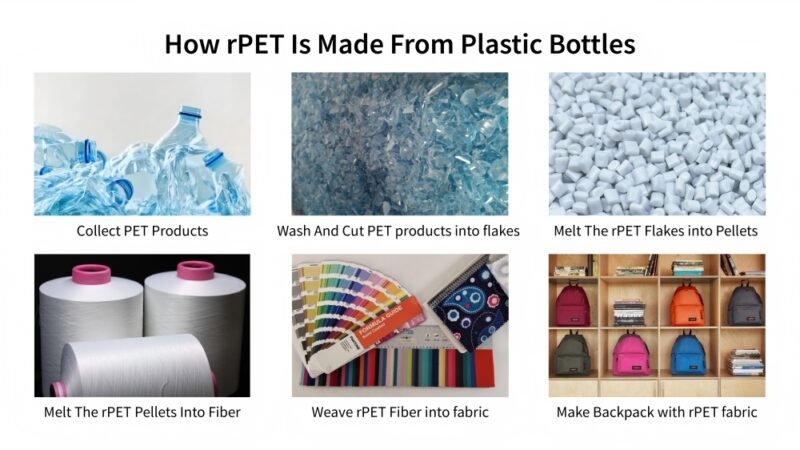
CO₂ Savings Compared to Virgin Polyester
On average, producing 1 kg of rPET saves roughly 1.5–2.0 kg of CO₂ compared to virgin polyester.
Factors influencing CO₂ savings include:
- Electricity mix used in recycling vs. virgin polymer production
- Transportation distances for bottle collection and fabric delivery
- Processing efficiency of yarn extrusion and finishing
Example: A 600D rPET backpack weighing 1 kg can save up to 2 kg of CO₂ emissions, equivalent to driving a car ~8 km.
Additional Environmental Benefits
- Plastic Waste Reduction: Every rPET backpack uses 20–30 recycled bottles.
- Energy Efficiency: Recycling consumes up to 50% less energy than producing virgin polyester.
- Landfill & Ocean Waste Prevention: Recovered PET reduces pollution and contributes to circular economy goals.
Factory Perspective
From a Chinese backpack manufacturer viewpoint:
- Using rPET allows us to offer eco-labeled backpacks with verified CO₂ savings.
- GRS-certified rPET batches provide transparent reporting for ESG purposes.
- Life-cycle analysis helps brands communicate measurable sustainability impact to consumers.
- rPET fabrics maintain quality, durability, and handfeel while delivering environmental benefits.
FAQ
How much CO₂ does rPET save per kg?
Producing 1 kg of rPET saves roughly 1.5–2.0 kg of CO₂ compared to virgin polyester, depending on energy and transport factors.
Does rPET affect backpack durability?
No. rPET fabrics match or exceed virgin polyester in abrasion resistance, tear strength, and color retention.
How is CO₂ savings calculated?
Through life-cycle analysis (LCA), considering raw material sourcing, recycling, production, and transport emissions.
Can brands use rPET CO₂ data in marketing?
Yes, if the material is certified (e.g., GRS) and backed by batch-level documentation or TC certificates.